.png)
Newly Released ICJ Report Confirms Sham Nature of Nagorno-Karabakh Political Trials in Baku

In January 2024, the Parliamentary Assembly of the Council of Europe (PACE) declined to ratify the credentials of the Azerbaijan delegation. The reasons included the imprisonment for political reasons; the inability of the Assembly’s Monitoring Committee rapporteurs to meet with detainees, the absence of free and safe access through the Lachin Corridor; credible allegations of “ethnic cleansing” and Azerbaijan’s lack of cooperation with CoE monitoring mechanisms. In its resolution, PACE reiterated its concern about the lack of separation of powers in the country, the erosion of independence of the judiciary and the deterioration of the overall human rights situation. Of particular concern was the low rate of implementation of ECtHR judgments, including leading judgments regarding independence of lawyers.

Washington, D.C. – The Armenian Assembly of America (Assembly) welcomes a newly issued report Justice Under Pressure: Independence of Lawyers and the Right to a Fair Trial in Azerbaijan by the International Commission of Jurists (ICJ) regarding Azerbaijan. The ICJ is an international non-governmental organization of leading judges and lawyers working to promote human rights and the rule of law across the globe.
The ICJ report has produced a detailed and meticulous exposition of structural and institutional flaws in the Aliyev regime’s entire justice system with specific application to those flaws in the trials of the former Nagorno Karabakh officials, globally considered as political show trials without any real legal basis. The ICJ’s findings provide timely and crucial insight into the domestic situation in Azerbaijan, which directly affects the lives of Armenians and poses a threat to long-term regional stability.
The analysis pays particular attention to the Azerbaijan government’s control of criminal defense and all other lawyers but also details with citations the authoritarian control exercised by the regime over all aspects of the criminal process. This begins in the pretrial stages, includes access to materials and to imposition of government-controlled defense counsel, and runs through interpretation/translation control, prosecutorial control, retaliatory discipline, torture, and detention conditions.
"In the context of its newly released report examining the independence of the legal profession in Azerbaijan and assessing its impact on the right to a fair trial, the Justice Under Pressure: Independence of Lawyers and the Right to a Fair Trial in Azerbaijan provided the most detailed and credible exposition the facts, circumstances and legal analysis concerning what are widely acknowledged as show trials of the 23 political and civilian Armenian Christian hostages seizedfrom Nagorno-Karabakh by the Aliyev regime. The report’s credibility is preceded by the ICJ's stellar reputation as an independent body and enhanced beyond reproach by its level of detail from public and confidential sources," said Assembly Executive Director Bryan Ardouny.
“The Assembly and all those concerned about justice not only welcome this work and thank the Commission but also urge governments to stop turning a blind eye to the fate of these hostages and the destruction of Armenian Christian presence in Artsakh and elsewhere and take concrete action. We also extend our hope that the same shortcomings are cured for the benefit of Azeri citizens suffering from the same dictatorial regime and repeat our calls for the United States Government to implement and enforce existing sanctions on anti-terrorism, genocide prevention and other laws as written and supported by the American people."
The report concludes with recommendations to the Aliyev government of Azerbaijan, the government prosecutors, Azerbaijan’s Parliament, and to the Council of Europe. As was widely reported, President Aliyev defiantly announced that Azerbaijan suspended respect for decisions of the European Court of Human Rights, and because of its well-documented abuses and genocidal pattern Azerbaijan is no longer a member of the Parliamentary Assembly of the Council of Europe. The autocracy also severed ties with the European Parliament following the EU’s recent resolutions calling for the immediate release of the NK trial hostages. Earlier this month, President Aliyev, speaking by video at the European Political Community Summit, used what should have been a forum for peace to rehash failed arguments rationalizing his genocidal policies.
The Assembly believes the implementation of the Commission’s recommendations is essential for fostering the potential for a lasting, positive peace between Azerbaijan and Armenia.
Azerbaijan – a country with a consistently poor and deteriorating human rights record – remains in the spotlight of major transnational human rights stakeholders. Ranked among the most repressive petrostates in the world, the Azerbaijani regime is regularly criticized by international watchdogs for its domestic repression and severe crackdown on opposition voices.
Freedom House, for instance, recently assigned Azerbaijan its lowest rating, citing “persisting authoritarianism” and “little interest in democratic change.” Human Rights Watch has also consistently characterized Azerbaijan as a repressive regime that “severely restricts the freedoms of expression and assembly,” while also documenting ongoing “cases of torture and ill-treatment in police custody and places of detention.”
The U.S. Department of State’s latest Country Reports on Human Rights Practices likewise highlights serious concerns, including “credible reports of arbitrary or unlawful killings, torture, cruel, inhuman, or degrading treatment, arbitrary arrests, and other serious abuses.” Azerbaijani human rights activists report that there are currently nearly 300 political prisoners in the country, including journalists, bloggers, opposition leaders, and human rights defenders. To avoid international accountability, in 2025 Azerbaijan also ordered the closure of the International Committee of the Red Cross office in Baku.
Azerbaijan’s continued violations of international human rights standards are reflected in the regime’s long-standing anti-Armenian stance. Decades of discrimination and attacks on the fundamental rights of the indigenous Armenian population of Artsakh (Nagorno-Karabakh), along with repeated military assaults and occupation of parts of the Republic of Armenia, have become the cornerstone of the regime’s regional policy.
In 2022, Azerbaijan violated fundamental international human rights norms by imposing a total blockade on Artsakh (Nagorno-Karabakh), threatening the lives of 120,000 people through starvation and lack of access to healthcare. In September 2023 – after nearly ten months of blockade – Azerbaijan launched a lightning offensive, attacking communities and committing war crimes against defenseless civilians in Nagorno-Karabakh. The attack forced the entire local population to flee to Armenia, fearing mass killings and repression by the Azerbaijani regime.
During the blockade and ethnic cleansing of Artsakh, Azerbaijan’s security forces captured and imprisoned under preposterous charges 19 Armenian prisoners and, unofficially, scores more. Among the Armenian hostages are the former democratic leaders of Artsakh, including three Presidents, former State Minister Ruben Vardanyan, and other high-profile officials as well as civilians.
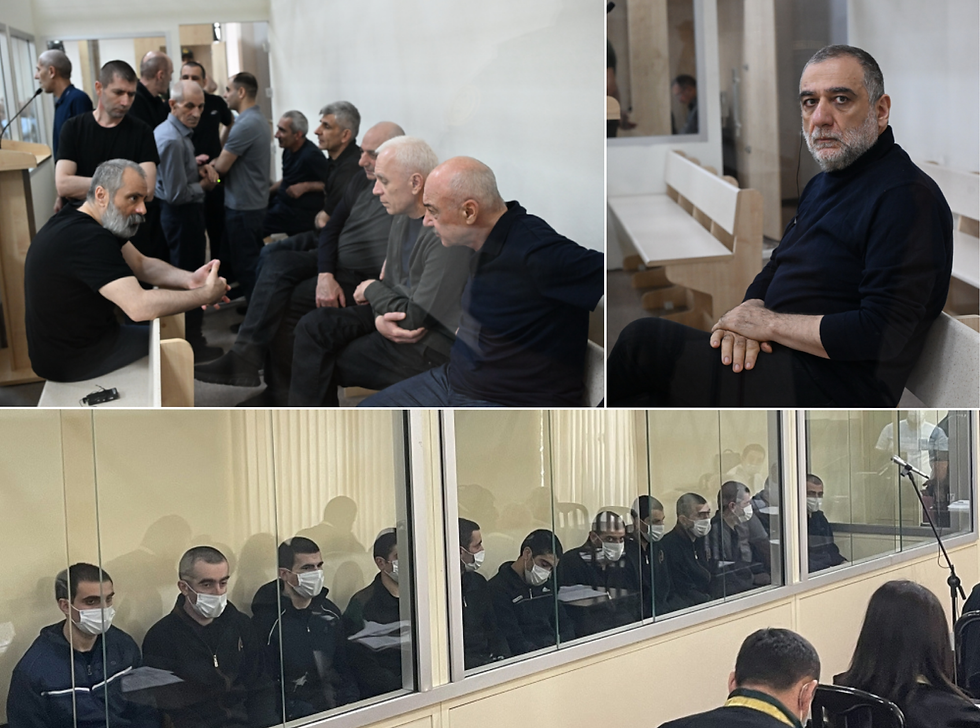
The Baku court proceedings, which began in January 2025, have been marred by serious due process violations, including a lack of transparency and the denial of adequate legal representation. Armenian detainees are reported to have been subjected to torture and other forms of cruel, inhuman, and degrading treatment, including prolonged deprivation of sleep and drinking water, as well as other abusive practices. In January 2026, they were sentenced to prison terms ranging from 15 years to life imprisonment. Two of the prisoners — Ruben Vardanyan and David Ishkhanyan — have recently appealed to the Human Rights Defender of Armenia, citing violations of due process by Azerbaijan’s courts and requesting a visit to the hostages, as well as the use of “all available humanitarian and legal mechanisms” to ensure independent monitoring of the safety, health, and dignity of Armenians held in Azerbaijan’s unlawful custody. Baku has rejected cooperation between the human rights offices and ordered the transfer of the Armenian prisoners from the State Security Service detention center to the high-security Umbaki prison.
The ICJ’s report covers additional violations of basic fairness standards and international law concerning jurisdiction, misapplication of applicable law, use of military courts, systemic and judicial corruption, protection against self-incrimination, accepted humanitarian law, lack of media, public, and international access to trials, and more which put to rest any claim of legitimacy of the NK trials or creditworthiness to the Azeri legal system. To this day, Azerbaijan refuses to release the Armenian hostages.
Aliyev’s regime also continues anti-Armenian policies and violations of international norms by targeting Armenian history, culture, and regional identity in the South Caucasus. A policy of systematic destruction of centuries-old Armenian Christian churches, cemeteries, and cultural monuments in Artsakh is being carried out. The breadth of this vandalism is widely documented by independent observers who are tracking the measures. The most recent tragic examples include the destruction of Holy Mother of God Cathedral in Stepanakert, the capital of Artsakh, and the demolition of the memorial dedicated to the victims of the Armenian Genocide perpetrated by the Ottoman Turks in 1915. In light of these policy public statements by Azerbaijani officials laying claim to sovereign Armenian territory – including references to parts of Armenia as “Western Azerbaijan” can only be interpreted as a steady stream of threats.
The 2026 Report by the United States Commission on International Religious Freedom (USCIRF) recommended the US Government to maintain Azerbaijan on the Special Watch List, highlighting growing concerns regarding the protection of Armenian religious and cultural heritage sites in and around Artsakh. Documented violations include the destruction of Armenian religious sites, churches and cemeteries, as well as alteration and misappropriation of the Christian Armenian heritage.
Established in 1972, the Armenian Assembly of America is the largest Washington-based nationwide organization promoting public understanding and awareness of Armenian issues. The Assembly is a strictly non-partisan, 501(c)(3) tax-exempt membership organization.
###
NR# 2026-12


